
Ancestral Connections with Trowse
This blog post was originally published here: https://joemasonspage.wordpress.com/2018/01/23/ancestral-connections-with-trowse/
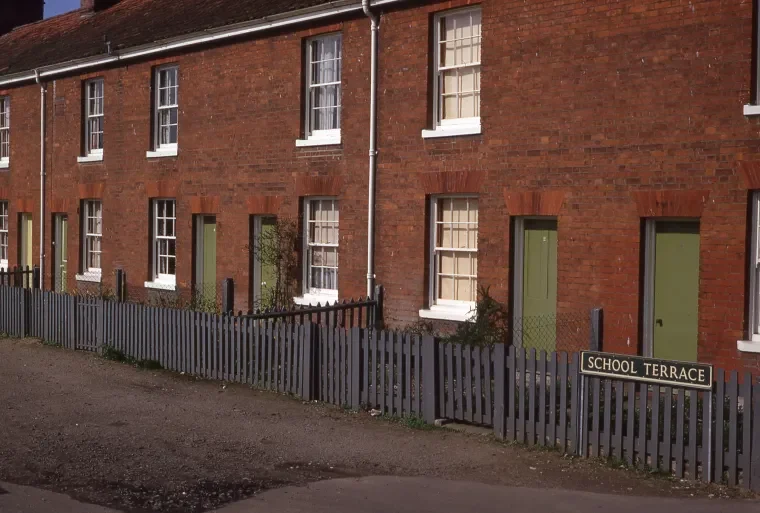
The row of terrace houses along White Horse Lane in Trowse Newton is called Russell Terrace. The terrace was built in about 1880 by the Colman family who developed Trowse as a model village to house their workforce from nearby Carrow Works. It was named after Russell Colman, born 1861, the grandfather of the current head of the family Sir Timothy Colman. The view from the front room looks out over the common; the land had been given to the parish by Jeremiah Colman (Russell’s father) in the last quarter of the nineteenth century. Until then this land had been an area of slum dwellings. The Post Office was only a short distance from Russell Terrace, and a baker’s shop used to be on the corner of White Horse Lane. It is now a vegetarian café.
The house where Charles Mason (my great-grandfather) lived was number 25 Russell Terrace. It could hardly have been more conveniently situated in those pre-motor transport days. A short walk would have brought Charles’s and his family to Trowse railway station, and from the beginning of the 20th century, the tram stop was adjacent to the railway station. A short bike ride would take Charles to his place of work at Carrow, where he was a carter at the mustard mill. A Sunday afternoon stroll down White Horse Lane would have brought them to the ancient walled Roman town at Caistor St Edmunds, while travelling a similar distance in the opposite direction would have brought Charles to the river Yare at Whitlingham staithe. This was still a place of great industrial activity in 1880; a short tramway ran from the kiln to the riverside to transport lime to the wherries at the staithe, from where it was carried to the Norwich builders. A rowing boat ferry service was on hand to transport workers from Thorpe St Andrew, across the river.
Trowse Newton was a country village in spite of its proximity to the City, and it was quite possible to get lost in the woods around. Charles Mason did just that, and was eventually found by a local who heard his desperate cries of “Lost! Lost!” This gave him his nickname, and forever after he was called “Lorst” Mason by his friends. Charles Mason always spoke in his native Staffordshire accent, and I cannot tell you how they pronounce the word ‘lost’ over there, but in East Anglia it is always said like this: “lorst”.
During the First World War two Scottish soldiers (twins) were billeted on the Masons at Russell Terrace. Sixteen year old Edith, one of Charles’s daughters, took quite a shine to one of the brothers! At the start of the war there were still several children living in the three bedroomed house; it must have been a bit cramped with the soldiers sleeping there too. However it was all part of the war effort, and the extra rent must have come in handy for the family.
Charles Mason’s family of ten children were all brought up at 25 Russell Terrace. The eldest children had moved out by 1921, but his two youngest daughters remained there with their aged father. After the foundation of the BBC in 1922 (with Norfolk educated Scotsman John Reith at its head) Charles Mason acquired a crystal set. These early wireless sets required no mains or battery current to power them, and were operated merely by the radio waves themselves. It would however have required a long aerial in the back garden, to pick up the signal. As a consequence of the low power there was no loudspeaker and they had to be listened to using headphones, so wireless listening was not at first a group activity. The broadcasts were initially limited to an hour a day, but radio grew with incredible speed, and before Charles Mason’s death in 1938 an experimental television service was being broadcast in London.
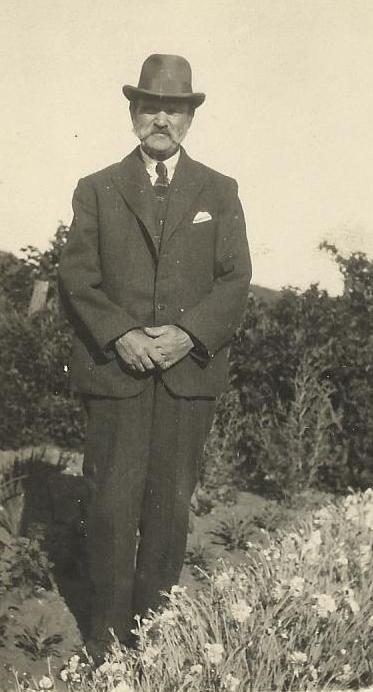
Charles Mason belonged to a fortunate generation; unlike his forebears he was literate and well housed. He was able to retire in his mid-sixties. Only a few years before most people had faced the prospect of working until they dropped, or starving in their old age. The great reform had come shortly before the First World War, when people were able to retire at the age of 70 without having acquired any savings first. This happy period of a pension for life from the age of 65 lasted less than a century, and now the age of retirement is creeping up again, and inevitably will again reach seventy at least. Charles was able to enjoy a long retirement at Russell Terrace, and after his death his daughter Florence (and her husband Billy) carried on the tenancy. During his years of leisure in retirement Charles spent much of his time in his beloved garden and allotment in Trowse. While virtually all of his fellow gardeners used their allotments to simply to grow vegetables, he used his to grow flowers as well. This puzzled and amused his contemporaries.
Summer holidays were family affairs, going to one of the local coastal resorts on the train. Compared to his father or sons (who died in their sixties or earlier), he enjoyed a long retirement of nearly fifteen years. I have no reason to believe it was not a happy one, but there had been tragedy too in his life; his twin sons John and Joseph had died as infants in 1892, and son Alfred had been killed on the Western Front less than a week before the Armistice in November 1918. Charles’s first wife had died aged only 38, and his second wife before she was sixty years old.
JOSEPH MASON