
A historical journey through the streets and houses of Trowse Newton.
Appendix 1 - Townscape and Buildings
5) White Horse Lane
(a) East side
School Cottage (1895), though detached, is in the same style as, and visually forms part of, Chapel Place. This continuity gives added “strength” to this important corner. Its railings survive and are continued by the railings of the school playground on the corner of Dell Loke. Trees along the edge of the playground soften a space, which is really little more than a yard.

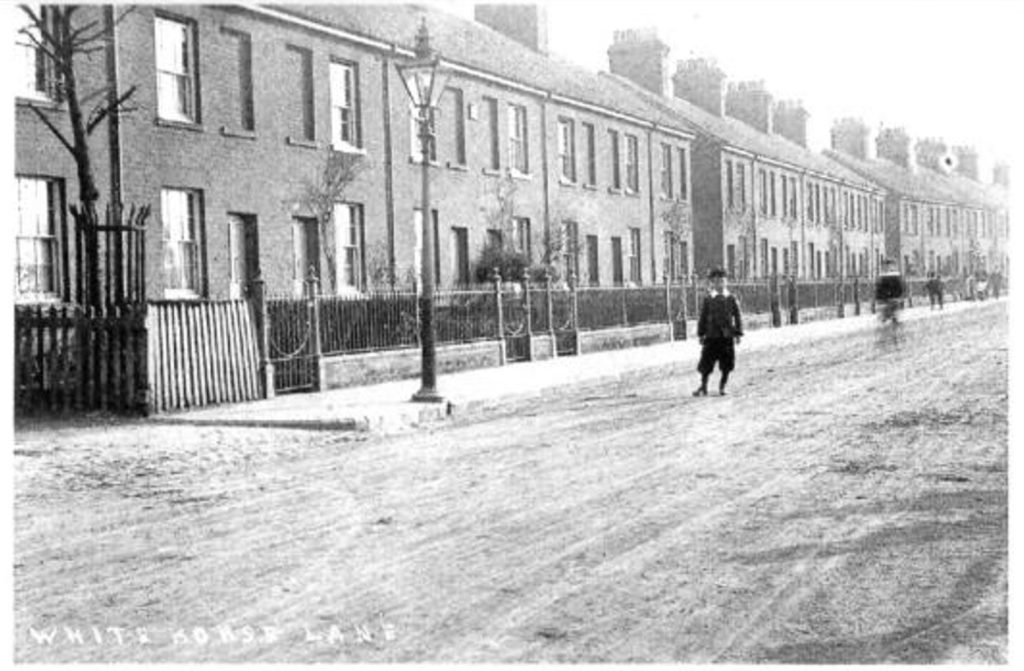
Russell Terrace is the glory of Trowse. It comprises four identical short blocks, each of eight houses: the northern two at a slight angle to the southern two. The relationship of the whole terrace to the open Common in front is in the tradition, albeit at a much humbler scale, of some of the grand crescents or parades of Bath or Brighton. The uniformity and simple elegance of the houses and railings allows the terrace to be seen as one, each individual house enhanced by being part of a grander whole. It is nothing less than a tragedy that, following the sale of the houses to individual owners, so many of them have been altered by the insertion of a multiplicity of different types of windows and doors.
Nos. 33 and 34 are a semi-detached pair of houses, dating from the early 1960’s. No.35 is a large bungalow of similar date. They have little architectural merit and “blur” the otherwise clear distinction between Russell Terrace and the surrounding landscape. An old flint wall survives to “pull together” the frontages of the three new houses. The rest of the Conservation area on this side of the road is still farmland. It is important that it should remain so, in order that the form of the “model village” is not further ‘blurred”.
(b) West side
The Common stretches southwards to the end of Russell Terrace. Trees have been planted at the southern end: two are now growing to the scale required for their site, but the third is of too small a species. The solidity of the posts and rails along the full length of the Common complement the delicacy of the cast iron railings, which run the full length of Russell Terrace. There is a fine open view from Russell Terrace over the Common towards the Street, the Church and the meadows of the Yare Valley beyond. In summer substantial trees mask views of County Hall and the wooded ridge beyond the river valley.
Two houses, built immediately south of the Common since 1967, like those opposite, ‘blur’ the setting of older buildings in the rural landscape and are architecturally of little merit. The use of a pink sand-lime brick is alien to the village, and changes in cladding “stone” facing and PVC ‘boarding” respectively – mean that they no longer match even one-another. It is unfortunate that the flint wall, which previously fronted their site, was demolished.
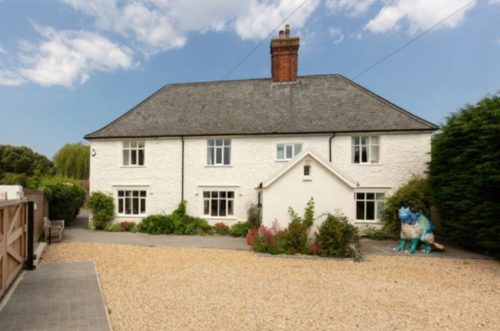
Old Hall Farmhouse, listed and dating from around 1740, with later alterations, is of colour-washed flint with a steep slate hipped roof. The stack right of centre suggests an original ‘lobby entrance” plan, old fashioned for this date. It has a good high flint wall in front, but the need to provide access to the converted barns next door has caused the front garden to be drastically reduced and the house now appears hemmed in.
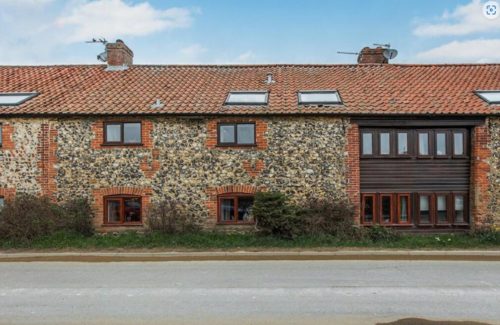
The conversion of the barns and other farm buildings, once part of Old Hall Farm, has enabled them to survive with their external character largely intact, though inevitably the insertion of new windows, roof lights and flues has to an extent changed their appearance. They sit well in the landscape and are visible from many vantage points.